Friday, June 17, 2011

5 Reasons Why Authors Should Speak at Service Clubs


Last week I went to speak to the women's Probus Club at Mona Vale, and I had the most fabulous time. The ladies were friendly and interested, they asked intelligent questions, they bought the book and they treated me to lunch afterwards. Now how many author gigs are as satisfying as that?
Some first-time authors have questioned whether such events are worth their while, wondering out loud if the time and effort (and yes, it takes both) pay off.
I am of the opinion that they do, well and truly, so here are my Top 5 Reasons Why Authors Should Speak at Service Clubs:

  1. Book Sales - Out of all the events I do, I find that I sell most copies at service club talks. The people that belong to these clubs tend to be readers, and the kind of reader that is interested in expanding their horizon. If you have spoken engagingly and interestingly, they can easily be persuaded to buy your book. I make sure I have a nice display of my book placed prominently; with a notice saying how much it is (some people are too shy to ask). I also use gorgeous fabrics to make the table look a little more interesting and exotic, and bring in one of my Vietnamese statues to be a talking point, and to bring people's eyes to the books for sale. I normally mention subtly during the talk that the book is for sale, but I also try to get whoever is introducing and thanking me to mention it as well. There is an excellent article by Stephanie Chandler on how to sell the book at the back of the room that I always consult - have a read. Once the talk is over I plonk myself down next to the display, pen in hand, and wait for the line to form.
  2. Brand Building - No matter where the club is situated, the people who belong tend to be the movers and shakers in their community. I find they buy books not only for themselves, but to give to family and friends who they think might be interested. And remember, particularly if you are speaking to a group of retirees, you are not just talking to them. Indirectly you are talking to their children and their grandchildren, and they could well become your advocate to the younger members of their family. If they liked you they will talk about you, and keep an eye out for you in the future.
  3. Getting More Speaking Engagements - Once you have wowed one group you will find yourself suddenly getting invites from other groups all around the city. Speaker organisers tend to know one another, and will phone around if they "discover" someone new. This provides a publicity-hungry author with an amazing network, and a whole host of new opportunities to hone their skill as a speaker. Probus keeps an official list of available speakers, and you can ask to be put on that. I'm not sure if other clubs do the same - would like to find out.
  4. Testing New Stories and New Material - Club talks tend to be far longer than most author presentations (normally around 40 minutes to an hour), and so offer an opportunity to try out some new stories in addition to your tried and tested, guaranteed fabulous, shtick. If people react well to a new story, you know you are on a winner. I also find that the questions I get are actually quite stimulating, and give me clues as to what I might need to develop in my future work, or what I could turn into a blog article or eBook.
  5. Contributing to the Community and Giving Authors a Good Name - OK, I know altruism is not normally a consideration when it comes to self-promotion, but it is worth remembering that the clubs are service clubs, and contribute a tremendous amount of money and energy to good causes. Through entertaining their members you help encourage more people to join and to become actively involved, and that is no small feat. By giving your time and talent freely you are contributing further to the club's good work, and helping members realise that writers are also a magnanimous, humanity-loving bunch.

Sunday, June 5, 2011

Vegetarian Fundraiser, Vinh Nghiem Vietnamese Buddhist Temple, Cabramatta, Sydney


A major form of fundraising for the multitudinous Vietnamese Buddhist temples in the suburbs of Sydney is the big vegetarian banquet.


These are immensely popular community events, with singers, raffles and legions of bored looking husbands standing out the front of the temple, smoking.
The noise is almost deafening, and you have to shout at everyone you meet, including normally quiet monks and nuns.


These crowded, noisy events are usually not for me. I prefer the temple when it is quiet and when there are fewer people around.
But for those who have less time to visit the temple at irregular hours, these special days provide a welcome opportunity to cultivate some good karma, have some lovely traditional food and kick back with friends while listening to some old tunes.

Thursday, May 26, 2011

Progoff Journal Workshop in Sydney


One of the things that has really inspired me over the years and encouraged me in my quest to become a writer is the Progoff Journal method. I have done the workshop several times, and have found the results to be incredibly inspiring and profoundly moving. Unfortunately this year I cannot make the workshop, conducted by the extraordinary Kate Scholl, but if you are interested in self-development and deepening your awareness, I don't think there is a better way you could spend your weekend:

Intensive Journal Workshops (Sydney) return

Intensive Journal® Life Context Workshop
4-5 June, 2011 Sat 9:30am - 5pm; Sun 9:30am - 4pm

Venue: The Centre for Ministry ‘Garden Room’, 16 Masons Drive, North Parramatta

Begin the winter months by treating yourself to a weekend of engaging with your life in its many dimensions: personal relationships, career decisions, spiritual longings and social concerns. In a quiet and relaxed setting overlooking the bush, you will be introduced to a process of writing that enables greater awareness of inner strengths and resources and offers a dynamic method for dealing with issues and concerns.

In the Life Context workshop you work through carefully designed exercises of the Intensive Journal workbook, which becomes a means of drawing forth your potential and deepening your spirituality.

Kate Scholl has been leading Intensive Journal® workshops for 30 years and is passionate about their potential for enabling one to live more creatively and genuinely.

For more information about the Intensive Journal®, visit their website: www.intensivejournal.org

Cost $140 or $120 for Eremos members; $20 less for concession. All workshop materials and morning and afternoon tea provided. Please bring your own lunch and a 3 ring binder. Full details are on the attached PDF (link at bottom of page).

Places are limited, so please register by 30th May to avoid disappointment. To register please use the online booking form. If you would like to know more about the workshop, please contact Kate Scholl at the email address below or tel 0425 211 065.

Email: kscholl@optusnet.com.au

Wednesday, May 4, 2011

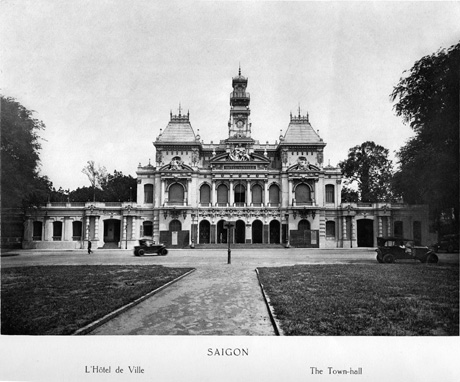
Saigon in the 1930s

From Osbert Sitwell's 1939 travelogue Escape With Me! An Oriental Sketchbook, describing his arrival in Saigon harbour:

"There were, even, little crocodiles of piously-dressed, slant-eyed, yellow-faced pupils to greet the nuns, and of lay-workers to greet the monks...Only the two French-Canadians, genial but suspect as ever, were left to themselves, wildly photographing gendarmes, customs-house officials and departing passengers alike.
But as we drove into the town, it became plain that Saigon was, in fact, an achievement, unique, a French city flowering alone out of a tropical swamp in the farthest corner of Asia. Once there, within its narrow confines, it is as though, in the manner of the polite fiction adopted by embassies the world over, you stood upon the actual soil of France."


Monday, March 28, 2011

Religion and Reconciliation

My dear friend the Ven. Bhikkhuni Thich Nu Tinh Van pictured at a recent conference in Singapore.
Ve. Tinh Van is one of Vietnam's leading Buddhist monastics, and an inspiration to women religious everywhere. She is also an accomplished Buddhist scholar. having earned her PhD in Pali studies and being a lecturer at the Van Hanh Buddhist Monastic University in Ho Chi Minh City.

Sunday, March 20, 2011

7 Ways to Pursue Your Writing More Seriously


As a published writer I frequently get contacted by friends, acquaintances and total strangers asking me for advice on how to more seriously pursue a career in writing. While I love answering these people in-depth and giving them all kinds of tips and leads, I also thought it might be helpful if I distilled this advice for anyone to read and act on. So here are my 7 Ways to Pursue Your Writing More Seriously:

  1. Enrol in a University writing course - This is controversial advice, as there are many people out there who will tell you that there is no need to do such a thing, that writing can't be taught etc. etc. Bunkum. Many of the most successful writers working today are the products of University-based creative writing courses. Even I, in my own modest way, can trace the trajectory of my professional writing career back to a University writing course. Ther are many reasons why such courses work: You are encouraged to think realistically about your writing and your market; you are placed in a competitive milieu which ratchets up your productivity, output and daring; and you have a lot of the really rough corners of your writing beaten out of you because of the constant criticism your writing is subjected to.
  2. Join a Writers' Centre - Such centres exist in most states in Australia, and in some regional areas. Again, they build a sense of milieu, and they offer great courses which will help you to refine your craft. They also tend to produce excellent newsletters filled with good practical advice for all writers.
  3. Sign up for a private writing course or workshop - These can be expensive, but they are so worth it. Just save your pennies and think of it as a holiday. The people who run these courses (and I think instantly of my great friend and mentor Jan Cornall) are dedicated, professional and in love with writing. They are also invariably interested in you and what you are writing - which can put them in a minority right at the beginning of your career.
  4. Go away and write - If you are on a budget, then go off to a cabin or a monastery and spend some time with you and your paper. No internet connection is a plus. Spend time with yourself and your ideas about writing. This is not meant to be where you really get started on your masterpiece (though it might well turn into that). It's more of a time for you to think and write and get every single idea, hope and goal down on paper. Take a half dozen self-help books with you and do all the exercises. Re-imagine yourself as an interesting, creative being. If you have the money and the time, think about doing an organised writing retreat in somewhere like Bali or Phuket - these can often be cheaper than you would imagine. Quite successful and accomplished writers run such retreats, so watch their websites and keep an eye out.
  5. Do The Artist's Way - Yeah, I know a lot of people will poo-pooh this suggestion, but the fact is that this amazing course in creativity has helped many very successful people to re-launch thier careers. Many places offer an organised Artist's Way Course and this would be even more of a plus.
  6. Join a local writing group - This is separate to joining the bigger and better organised state writers' centres. Local groups can be chaotic, filled with every kind of eccentric. But I found my involvement to be immensely valuable in helping me to conceive of myself as a writer once more. And they can provide plenty of material for later stories.
  7. Read, read, read - I am always bothered when people who don't read want to start writing. I'm gonna put my neck out here and say that there has never been a really good writer who wasn't also a voracious reader. I once went to hear British novelist Jeanette Winterson speak, and she said that universities should be offering creative reading workshops as well as creative writing workshops. If you are just launching yourself back into writing I would suggest you push your laptop aside for a month and do some solid reading. Read half a dozen or so books on writing; a few self-help and inspirational books; a few biographies of great writers; and at least the current Top 10 bestsellers in whatever genre you want to write in.
So there it is - my Top 7.
These tips are intended for people who have maybe put their writing aside for many years as they attended to a more sensible career.
I would love to hear from people with other tips, or more detailed information on the suggestions I have listed here.

Sunday, January 30, 2011

Tet at My Neighbourhood Temple


I live in the heart of Vietnamese Sydney, and am surrounded by at least a dozen Buddhist temples. If you hop in the car and venture further afield there are probably closer to 20.


But one of my favourites is the little house temple closest to me - Chua Minh Giac.


I visited on the weekend, when they were getting ready for the Lunar New Year.
Here is a little video of the surrounds, and some lovely pics of the main shrine taken by Thang.