Wednesday, November 10, 2010

Water Dispenser Outside Church, Le Van Sy St.


One of the most touching sights in Ho Chi Minh City is the humble water dispenser many Catholic churches leave on the footpath outside. In a city where clean, drinkable water is hard to get, this is a small act of charity that is immensely useful, and, to my mind at least, quite admirable.
These dispensers are filled up with clean water throughout the day, and the thousands of people who work, travel or live on the streets of this enormous city know they can walk by and grap a cupful whenever they want it. The sign on the side says "No Charge."
This particular photograph was taken on Le Van Sy St. in Phu Nhuan, outside the beautiful Ba Chuong church.

Saturday, November 6, 2010

Amitabha Buddha


The name you will hear most consistently if you spend any time in Vietnamese Buddhist temples is that of Amitabha Buddha - or A Di Da Phat in Vietnamese. In his fascinating book Buddhism in America, Richard Hughes Seager calls Amitabha "among the greatest of the cosmic buddhas of the Mahayana tradition."
The vast bulk of Vietnamese Buddhists practise a basic form of Pure Land Buddhism, and for the most part the monks advocate recitation of Amitabha's name as the most effective form of religious practice for lay-people. This is what all of those wrist malas and long prayer beads are for.
Within the temple, Amitabha's name is also a kind of shorthand replacement for everything. When you say hello, you say A Di Da Phat, when you say goodbye, when you want to attract someone's attention and when you express surprise. Once I was at temple when one of the large vases that are found in the main prayer hall tumbled over and smashed, and a number of monks looked up and exclaimed, as one, A Di Da Phat!
The true form of Buddha recitation is, of course, Nam Mo A Di Da Phat. This is enunciated clearly during communal temple worship, but at other times it is shortened to Mo Phat, and this is in fact the standard greeting amongst Buddhists, both monastics and laity.
Despite his name being constantly on everyone's lips, statues of Amitabha Buddha are not normally very prominent at temples. It is rare to have him as the main object of devotion in the prayer hall, and he is rarely seen on other shrines. Normally there is a printed image of him on the wall in the monks' offices, or a small statue on a shelf somewhere. People seem to set much greater store on statues of Kwan Yin and Sakyamuni Buddha.
One place where an image of Amitabha does become important is at people's death beds, which is why monks always have a small-ish statue of him to hand to take to hospitals and houses of the faithful, should the need arise. It is thought that if the dying person lays eyes upon an image of Amitabha, they will be reborn in his paradise. In Tibetan Buddhism there are much more elaborate forms of Amitabha worship involving initiations and various other practices. But in Vietnamese Buddhism the devotion to Amitabha is restricted to the recitation of his name while using the rosary and, in a very few temples, the chanting of the Amitabha Sutra.
The image with this post is from the large Buddhist nunnery that stands atop the mountain overlooking Phan Thiet. It is part of a massive reproduction of the Pure Land Trinity that stands on a sunny terrace carved into the side of the mountain.

Wednesday, November 3, 2010

Walter Mason to appear in the Writers' Tent at the Newtown Festival Sunday 14th November


I'm very honoured to be appearing in the Writers' Tent at this year's Newtown Festival.
The Tent, sponsored by King St literary institution Better Read Than Dead, is THE hotspot of the Festival, featuring a really fascinating range of authors (including my good friend Geesche Jacobsen) talking about their books and their craft.
I'll be In Conversation with the terrific Maggie Hamilton, and I'm sure she'll drag insights, profundities and epiphanies aplenty out of me.


Please come along and hear me!


Newtown Festival - Writers' Tent
Sunday 14th November
3.15pm


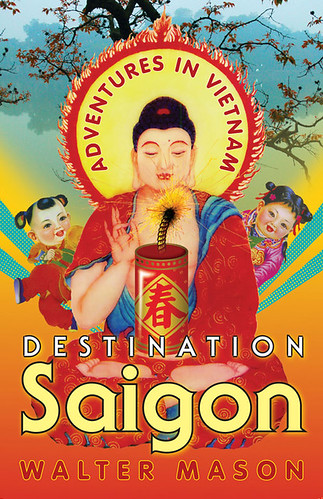
Destination Saigon: Adventures in Vietnam with Walter Mason

From the crazy heat and colour of Saigon to the quieter splendour of Hanoi, Walter Mason gives us a rare, joyous, at times hilarious insight into contemporary Vietnam.
Seduced by the beauty and charm of its people, the rich variety of foods, travel off the beaten track to far-flung villages in overcrowded buses or perched perilously on motorbikes.

In conversation with publisher Maggie Hamilton.

Tuesday, November 2, 2010

Crowded Buddhist Shrine - Long Khanh Temple - Quy Nhon, Vietnam


People often have a romanticised idea of the Buddhist aesthetic. Actually, people hold all kinds of unrealistic notions about many aspects of Buddhism, but the great cliche is that of the clutter-free, ultra-simple, zen-like atmosphere.
I'm here to tell you that Buddhist temples and monasteries are not like that. Especially not in Vietnam.
This is a shrine in a senior monk's room at the largest temple in Quy Nhon City. Actually, as these things go, it's quite restrained - I've certainly seen far more crowded shrines in my time.
But you can see, there's a certain dedication to colour, and plenty to catch the eye.
I actually like my Buddhism like this: colourful, chaotic, unpretentious and appealing directly to common ideas. I love that life in Vietnamese Buddhist monasteries can be chaotic and crowded, the shrines dusty and filled with tat.

Monday, November 1, 2010

Bonsai in Buddhist Temples in Vietnam


Monks are, naturally, somewhat restricted in the pastimes they can pursue.
Though they may play sports on temple grounds, hidden from the eyes of lay-people, and they may get enthusiastic about watching soccer on TV, generally they are forbidden from really indulging in sport as a hobby. That said, I once knew a monk in Saigon who was a keen body-builder. He eventually gave it away after a few years - he had come to the realisation that body-building was not quite in the spirit of his monastic vows.
Literature is, of course, an admirable pursuit for monks, and those who are talented enough spend their time writing or translating.
If they are wealthy, monks can turn their hand to collecting - Buddhist art, old manuscripts and antique vases are popular. I even know a monk who breeds pekingese dogs in his leisure time, though for some reason this makes me uneasy.
Monks can work on becoming artists and calligraphers, and sometimes flower arrangers - all are admirable skills in a monastery. Some turn their hand to the occult, and work on becoming expert at the I Ching, Chinese astrology and palm reading - this is all, of course, technically forbidden, but plenty of monks do it.
But there are three hobbies that monks in Vietnam excel at, and all are, in my book, exquisite and approrpiate. They are: tea connoisseurship, the growing of orchids and the cultivation of bonsai.


Bonsai are ubiquitous in the temple courtyards of Vietnam, and monks deal and trade in them.


They can be quite expensive, and sometimes a monk is appointed as temple gardener in order to attend to the bonsai.
If a monk or abbott is really keen on them common areas can become somewhat over-crowded with these potted plants.


Some are also allowed to grow to enormous size - I'm not quite sure if, in this case, they are still considered bonsai (perhaps an expert can enlighten us?), but they are still cared for and cultivated in the same manner.


Popular mythology would have it that the roots (no pun intended) of bonsai lie in the patient care and eccentric eye of the Buddhist monks of antiquity. Certainly it is a stately, gentle pursuit, and one worthy of monastic attention.

Tuesday, October 26, 2010

Catholics and Christmas in Vietnam


The vast Catholic churches that serve the suburbs of Ho Chi Minh City are also home to eclectic book and gift shops tucked discreetly into side buildings. Around Christmas time they pack up the usual assortment of plastic rosary beads and plaster of paris statues of the Vietnamese martyrs and turn themselves into dazzling winter wonderlands, selling cards, nativity sets and all other kinds of Christmas paraphernalia to the people of Saigon, Christian and Buddhist alike. Christmas is big business in Vietnam, and the Catholic gift shops see themselves as the rightful source of festive tawdriness in all its manifestations. Courting couples hit the Catholic churches to browse the immense stands of cards, and maybe pick up a purple plastic Christmas tree or two. If its Christmas cheer you’re after, your local church will have it in spades.
Tan Dinh church, a pastel pink masterpiece of French provincial frippery at the best of times, is transformed by late November into a riotous Noel-themed fun park. Vast plastic pine trees, their limbs heavy with snow, are hot sellers, and outside the church individual entrepreneurs set up racks and racks of Santa suits in every size – except in sizes that Santa himself would actually fit. It is not unusual to pass someone driving his motorcycle dressed in full Santa regalia – indeed, I have driven past entire families all dressed as Santa balancing on a motorbike. The laws requiring adults to wear safety helmets probably put a dampener on things a little, but the merest suggestion of a red cap and white pom pom poking coquettishly from underneath a helmet is enough to offer a tantalising suggestion of Father Christmas. The only other modification is that Santa is invariably wearing flip-flops.

Sunday, September 19, 2010

Destination Saigon in Siem Reap!


I had a wonderful email from my old friends Beth and Peter at the Bay Bookshop in gorgeous Batemans Bay.
They have just come back from Cambodia (where, incidentally, I'm headed at the end of this year to write my second book), and they were overjoyed to discover my book, Destination Saigon, at Monument Books in Siem Reap International Airport!


How wonderful.
Last week I heard from a friend who has just come back from Bangkok, and he says that Destination Saigon is prominently displayed in the airport bookshop there, as well.
And of course, it continues to be a fixture at airport bookshops across Australia.
It's so woderful to hear that my little book has struck a chord with travellers to Asia, and a great big thanks to all of those shops that continue to support it!