Tuesday, May 26, 2009

Vietnamese Fabrics


I will confess to loving textiles. Wherever I go, I tend to bring back examples of local weaving. This can be a curse, because traditionally woven fabrics have a tendency to be heavy, and then one doesn't do much with them when one gets home. I once travelled days to a little village in central Thailand because a friend's mother was a weaver, and I would get to see her in action. I did, and I bought some exquisite pieces from her...but they have disappeared somewhere in the intervening years.
The best examples of Vietnamese weaving come from the Hill Tribe districts in the Central and Northern provinces. They are quite sturdy and heavy, but the materials themselves are usually of poor quality - colours run easily if washed, and threads pull and come unraveled at even the slightest use.
That said, I still adore their wonderful colours, and our house is generously be-draped with some wonderful large pieces I have brought back from my adventures.
There used to be some wonderful shops in the Pham Ngu Lao district of Ho Chi Minh City that sold Hill Tribe fabrics at quite a reasonable price, but they seem to have disappeared. There are one or two little boutiques left in Saigon that deal in the fabrics, but they are considerably more expensive than they used to be.
In fact, earlier this year I found it quite difficult to find traditional fabrics at all in any of the large cities. Like anything, I suppose that fashions in souvenirs come and go, and it would seem that traditional weaving is well and truly forgotten. Makes me wish I had bought more over the years.

Monday, May 4, 2009

Weddings

In Vietnamese culture, big parties are what keeps the social wheels lubricated.
Since recorded history, the Vietnamese have been willing to spend an inordinate amount of money on elaborate parties to celebrate weddings, funerals, engagements and death anniversaries. All and sundry are invited to these events, and the festivities last over several days - particularly in country areas, where there is not really any other entertainment available.
In this photo, taken at a family member's wedding in the early 90s, you can see the traditional gifts presented in red lacquered boxes and then covered with a red cloth. The red symbolises good fortune, and the gifts inside are themselves symbolic - esoteric things like fresh tobacco leaves, betel and black tea.
These days weddings are a huge industry, especially in Ho Chi Minh city where vast wedding palaces are busy 7 nights a week hosting elaborate wedding parties that know no boundaries when it comes to tackiness. When I was there earlier this year the big trend was elaborate guards of honour lining up outside the venues to greet the guests and, ultimately, the bride and groom. Some confined themselves to the traditional seven bridesmaids and seven groomsmen, but some show offs had retinues of twenty or more of each sex. Wedding halls are hung with vast portrait photographs of the the happy couple, normally taken weeks before. These are generally real tributes to the art of digital manipulation, and even the most humble couple take on glamorous proportions when blown up to 5 metres high and photoshopped to within an inch of their lives. Elaborate videos are also made of the proceedings, and no digital effect is spared in rendering an exceedingly tedious and long-winded social gathering moderately visually engaging.
Call me a curmudgeon, but I like to avoid weddings. They are interminable, and gift giving is reckoned according to perceived social status, and as a result I am expected to give something big - gold jewellery or a big gift of cash. Maybe I'm stingy, but in Australia all they'd get from me would be a blender, and I resent being forced to shell out big amounts of money to people I hardly know.

Friday, April 24, 2009

St. Andrew Dung Lac


It is always my contention that the Vietnamese (particularly in the Central and Southern regions) are a particularly religious people, and take their religion very seriously.
I also think it's interesting that Catholicism is, in fact, quite an antique spiritual tradition in Vietnam. Many assume that it arrived with the French in the 19th Century, but in fact there have been Catholics in Vietnam since the beginning of the 16th Century.
In the section of Ho Chi Minh City that I call home, vast numbers of Catholics reside, most of them descendants of Northern Catholics who fled the great persecutions of the mid 50s. There is a network of churches in the district, some of them, like the beautiful Ba Chuong church on Le Van Sy, quite enormous.
It is inside the Ba Chuong church that you can see a shrine to St. Andrew Dung Lac and his martyred companions. At various times throughout Vietnamese history the people in charge have been less than enthusiastic about Catholicism, and there are large numbers of martyrs. St. Andrew Dung-Lac is kind of the granddaddy of them all, and his feast day serves as the memorial date for 117 of the 19th century Catholic martyrs in Vietnam.
Though a shrine to these martyrs is a standard part of most church interiors, in terms of popular devotion they can't compete with Truong Buu Diep, St. Martin de Porres and, naturally, the Blessed Virgin. Shrines to these figures are ubiquitous, and more spontaneously attended.

Tuesday, April 14, 2009

Writing Creative Nonfiction


Well, big news is that I've actually started writing, which is none-too-soon as the manuscript is due at the end of June.
This whole book project came about because of a course I took with the simply wonderful Jan Cornall on Creative Nonfiction. I wrote a long piece on my history with Buddhist monks, and a publishing friend read it and the rest is history.....
The genre of Creative Nonfiction has always been a favourite of mine - indeed, among my favourite books are In Cold Blood and Midnight in the Garden of Good and Evil, both accepted classics of the genre. People don't normally associate travel writing with Creative Nonfiction, but of course it belongs firmly within the confines of the genre.
I have been enjoying and finding very helpful Theodore A. Rees Cheney's Writing Creative Nonfiction - surely the bible for those in the field? He has lots of interesting and helpful things to say, and at the moment I am struggling with his chapter on character. There are one or two key characters in my book (apart from myself) who are, naturally, real people to whom I am quite close. I have been finding it difficult to write about them - am I saying too much about them, or am I assuming the reader knows too much? And how do I avoid making myself sound very clever and those characters appear very simple and often silly. This is a real concern for me, because personally I hate reading authors who I perceive as arrogant or unaware of their own sublime stupidity. I always like grumpy old curmudgeons like Theroux who aren't scared of making themselves appear thoroughly stupid, or someone like Bryson who casts himself as the bumbling fool, and thereby avoids charges of arrogance.
I am also aware that I am a Western man writing about Vietnamese people, and with a head full of Edward Said I am terrified of coming across as a post-colonial dilettante and cultural plunderer oozing with condescension. I don't want to make the Vietnamese people, especially my dear friends, appear quaint.
But maybe that's a lost cause?

Tuesday, March 24, 2009

Monkey


While leafing through Harold Acton's exquisite Memoirs of an Aesthete I came across a passing reference to one of the Monkey stories, and I think I will include the quote in my book. I was suddenly reminded of how important the Monkey stories are in Vietnamese culture, serving much the same purpose that the Grimm Fairy Tales or the Mother Goose stories once served in Western culture. Various versions of the Monkey stories are endlessly repeated on Vietnamese television - Taiwanese, Japanese, Korean and even home-made series of greater or lesser artistry.
One frequently comes across statues of Monkey and his companions in temple gardens in Vietnam, reminding us that the stories always functioned as Buddhist propaganda, serving up fanciful moral tales in which Buddhist virtues (and Buddhist characters) always came out on top - normally trumping the foolish Taoist or folk-religion figures.
A few years ago a whole slew of books came out about the mythic Journey to the West, with people trying to re-trace the steps of the monk Hsuan Tsang and his animal companions. At the moment I am reading one of the better ones - Richard Bernstein's stately and meditative Ultimate Journey.
One of the most extraordinary things about the Monkey tales is how they made the leap to the West through the agency of the 1970s Japanese TV series that was so hilariously dubbed into English by out-of-work Royal Shakespeare players and seemed to play endlessly on the ABC throughout the 80s. A whole generation of British and Australian youngsters (myself included) became immersed in this East Asian epic, the greater philosophical and cultural significance of which went completely over our heads.

Tuesday, March 3, 2009

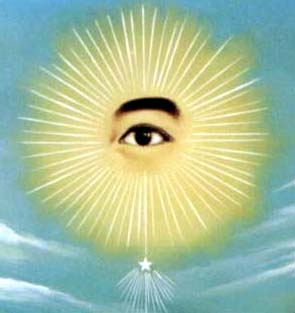
The Eye in the Sky


So often when I visited Cao Dai temples in Vietnam the old Alan Parsons Project song kept running through my head. "I am the eye in the sky, looking at you-o-o, I can read your mind..."
For that is very much what the central worship image of Cao Dai is: an eye in the sky.
The all-seeing eye of God represents to Cao Dai devotees the universal nature of the deity. God's eye sees all and God belongs to all.
The old Cao Dai teacher who was my friend at the Phu Nhuan temple in Ho Chi Minh City explained it to me this way: "Gos is one - there can only be one God. There is no God for Catholics, another God for Protestants, another for Buddhists. What a foolish way to think! God sees all, loves all, and belongs to all. God needs only one eye, and that single eye represents the unified nature of all of humanity, regardless of religion or race."
You can see why I always find Cao Dai such a seductive religion.

Sunday, March 1, 2009

Quan Am Temple, Cholon


I have been an enthusiast for Quan Am Temple in Cholon for many years now.
In fact, one of my abiding fantasies is to go and work there as a temple attendant for a few months and write a book about it - a la Gontran de Poncins' wonderful From a Chinese City.
I love District 5 and its crazy energy - especially at night. I love how the one place residents of Saigon consistently warn me against visiting is District 5 - allegedly many bad things happen there. Perhaps it's just lingering prejudice against the Chinese, or perhaps it's true? Cong An News, the trashy police tabloid that is read religiously by many in Ho Chi Minh City, delights in a good murder or violent robbery in District 5. In fact, it normally warrants a front page.
But by day my favourite place to hang is the colourful and crazily busy Quan Am Temple in Lao Tu street. The fact that this place is well and truly on the Lonely Planet beat doesn't bother me, because I have been hanging out there for many years. The foreigners drift in and out after taking a few snaps, but I have contacts among the incense sellers and fortune tellers and old ladies who clean the toilets, and am allowed to put my feet up in secret rooms and watch the non-stop activity at what must be one of Vietnam's busiest temples.
A few years ago this place was much more interesting, from a religious/anthropological view. It was a lot more run-down, and there were lots more shrines hidden about the place (which is amazing when you witness the sheer number of shrines that still exist within the temple complex!). Also, there used to be any number of lady shamans, clairvoyants and spiritual healers on the premises, ready to prescribe a religious ritual or two to advance the petitioner's good luck. An inflow of money from overseas Chinese communities has meant that the temple has cleaned up its act considerably, and the lady shamans and prophetesses were among the first things to go. It's kinda sad, but was probably necessary - the local authorities tend to take a dim view of When I spend a morning or afternoon at the temple I am treated as a special guest and ushered into one of the side rooms and fed royally with buns and fruit left on the shrines by devotees. It really is a wonderful way to while away some spare time while you are in Ho Chi Minh City, and I can't recommend it enough. Just pull up a chair somewhere near the main shrine room and brave the carcinogenic clouds of incense smoke.